Question of the Week:
What do quality professionals mean when they discuss "a visual workplace" and "visual controls"?
A: "Visual control" means positioning all tools, parts, production activities, and performance indicators so the status of a process can be understood at a glance by everyone, thus creating a "visual workplace."
The technique also is used to improve performance when processing a step or a series of steps, to reduce cycle time, to cut cost, and to smooth workflow.
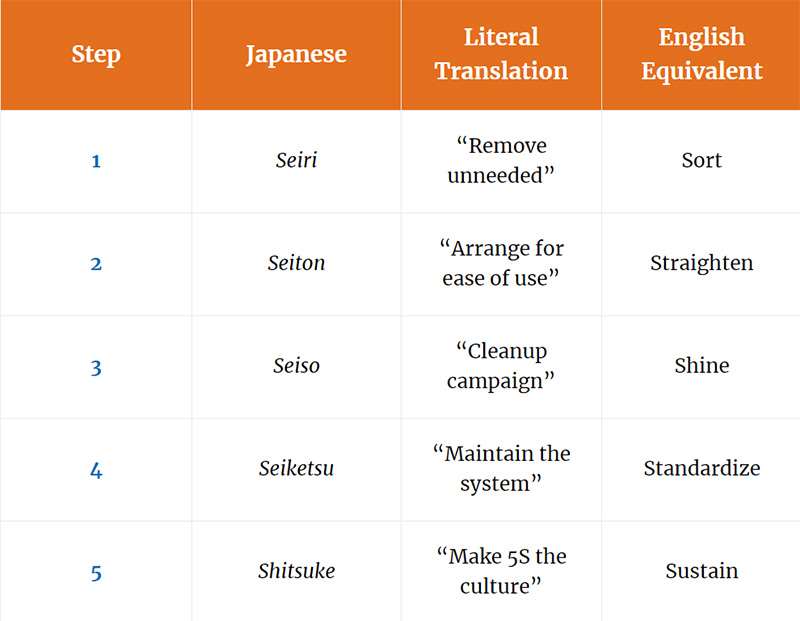
Visual control is often used in lean thinking, where it is closely linked to the 5S method: "sort, set in order, shine, standardize, sustain."
ASQ Articles:
A Second Look at 5S
by James Van Patten
Quality Progress, October 2006
This article suggests five activities to help facilitate initial 5S projects to ensure they are seen as the launch of a lifestyle, not just a step in a project. Logged-in members/subscribers: Instant Access. Or you can buy a PDF.
Make Healthcare Lean
by Anthony Manos, Mark Sattler, and George Alukal
Quality Progress, July 2006
The principles of lean manufacturing are as applicable to healthcare as they are to the automobile industry. But it’s not just cut-and-paste, obviously. This article discusses successful implementation of 5S in the healthcare field and details two projects where results were achieved quickly. Logged-in members/subscribers: Instant Access. Or you can buy a PDF.
Clean House With Lean 5S
by Christopher D. Chapman
Quality Progress, June 2005
Some companies try to implement the first 3 S-concepts only, hoping that if they sort, set in order, and shine, then "standardize" and "sustain" will take care of themselves. That mistake dooms a lot of reform efforts. Here’s how to implement a 5S system that lays a solid foundation for a lean production system. Logged-in members/subscribers: Instant Access. Or you can buy a PDF.
5S for Suppliers
by Kimball E. Bullington
Quality Progress, January 2003
Adapting the 5S concepts to streamline relationships with your suppliers. Logged-in members/subscribers: Instant Access. Or you can buy a PDF.
Use Symbols Instead of Words
by Gregg Stocker
Quality Progress, November 2002
A picture can indeed be worth a thousand words – if you implement visual operations management in a sound way. Here’s how (and why) to organize your visual communications effectively. Logged-in members/subscribers: Instant Access. Or you can buy a PDF.
Column -- One Good Idea: 5 Steps to Savings
by Sherri Gallagher
Quality Progress, June 2002
A look at 5S with an emphasis on efficiency and employee morale. Logged-in members/subscribers: Instant Access. Or you can buy a PDF.
5-S Practice: The First Step to TQM
By Samuel K. M. Ho and Stephen C. H. Ng
Quality Management Conference, Charlotte, N.C., January 1999
Since 1994 the Hong Kong Government Industry Department has promoted 5-S practice in Hong Kong, where it has been well received by the business community. As a result of this success, the Department commissioned a '5-S Practice Workbook' with ten successful case studies from the manufacturing, services, and public sectors.
Available in PDF format only: Buy a PDF.
Books:
The Visual Factory: Building Participation Through Shared Information, by Michel Greif. Cambridge, Mass.: Productivity Press, 1991. ISBN: 0915299674
Visual Systems: Harnessing the Power of a Visual Workplace, by Gwendolyn D. Galsworth. New York: AMACOM, 1997. ISBN: 0814403204
Five Pillars of the Visual Workplace: The Sourcebook for 5S Implementation, by Hiroyuki Hirano. Portland, OR: Productivity Press, 1995. ISBN: 1563270471
Visit the ASQ discussion thread on visual factory and document control.
And here’s a Web site devoted to visual-workplace issues.